Thorasta
Member
- Joined
- Jan 22, 2021
- Messages
- 48
- Media
- 20
- Reaction score
- 30
- Location
- Seattle, WA
- Grill
- Silverlight 810
I posted this on reddit and am reposting here:
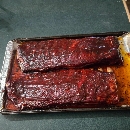
I've been improving my traeger brisket for several years now, and in some ways the lazier I get, the better the brisket has gotten. Here is my method.
In my opinion, before you start, you NEED:
- A system to accurately give you pit temp and meat temp.
- A thermapen or other accurate instant read thermometer for the end of the cook to find the coldest spot.
- Fill the hopper fully. I use the costco brand pellets, I can't tell one pellet type compared to another unless you use a really smelly wood like mesquite.
- 2 weeks before the cook, I find the biggest prime brisket I can find at costco that isn't all twisty.
- Choice briskets are okay, but the results haven't been quite as good.
- American Waygu: I tried it once and it came out weird. I do not recommend.
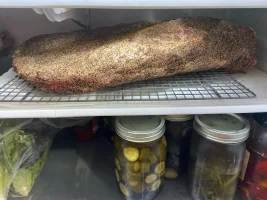
- I leave it in the bag in my fridge and let it age up for the 2 weeks.
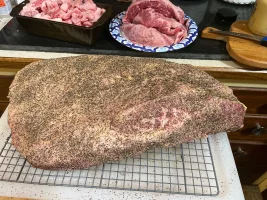
- 7 hours before cooking time I get it out, pat it dry with paper towels, trim it, salt, and pepper it individually.
- edit to add: After patting dry and trimming, I use mustard as a binder for the salt and pepper. I don't think the type of mustard matters, but seeing as I used dijon this time and it is the best brisket I've ever made, it is a data point to explore later.
- I used Diamond Crystal Kosher Salt. I salt sensibly - not sure how to describe this, play around until you like it. I can't prove it, but I believe salting 6-7 hours before cook is important.
- I use 16 mesh pepper that I buy on amazon. I pepper liberally. If your brisket is turning red instead of black, you aren't using nearly enough pepper.
- Put it in the fridge on a wire rack
- Fill the hopper fully.
- I put the trim fat in a couple of trays that get put in the top of the traeger to render for the entire cook.
- Sometimes I get a little meat trim, this last time I got a lot -- mostly because the butcher left a bunch more on the point than is normal so I trimmed it off. All meat trim gets salted and peppered - I eat the thin pieces about 4 hours into the cook -- I pull the thick trim pieces when the brisket is ready to wrap. Note -- if the meat fibers are longer than 3/4 of an inch, slice the trimmings to that length to avoid chewiness
- I clean and vacuum out the traeger if it needs it. I burn off the grills on my barbecue at max heat for 20 minutes or so, at least until it stops smoking.
- Hopper... Fill it fully.
- at 5:15 pm, I turn the traeger on and set it to 215 super smoke. I want the actual temperature at 200, but to get mine to 200, I have to set it to 215. You really need a 3rd party thermometer to figure this out, you can't trust the traeger readings. Before I figured this out, cooks were taking 6-8 hours longer.
- I put the fat trimmings on the top shelf and leave them there until I turn the traeger off.
- 6pm I put the brisket on.
- I am a FAT SIDE UP guy!
- I put two temp probes in the brisket, one in point, one in flat.
- I have a third probe that sits in the pit for pit temp.
- Fill the hopper fully (yes, I wrote this four times because I've run my traeger dry 3 times. I have the big Silverton that only costco used to sell so as long as it is completely full when I start I don't need to fill it again during the cook)
- wait 12 hours - set my alarm for 6am. NOTE: when the pit is at 200 degrees, you CAN NOT overcook the brisket. at least not within 18 hours for this first phase. I tried that once, it was overly dry.
- Ideally the meat is 170ish. I'm happy to wrap anywhere from 170-180. Sometimes I need to do higher heat for 30-60 minutes to hit that, sometimes I don't.
- Set the pit to actual temperature 265 (on mine I have to set it to 280 to get this result)
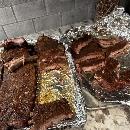
- Pull Brisket and remaining burnt end trimmings.
- Before wrapping in paper, I drizzle a little bit of the rendered tallow on top of it. I wrap it and put it back in.
- I put the probes back into it.
- When the lower temperature of the two probes hits 203, I take my thermapen and find the lowest temperature spot I can find. I put one of the probes into that spot and then wait till it hits 203 again.
- I do one last squish test to make sure it feels done and pull the brisket.

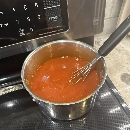
- Take the rendered tallow, and pour it through a paper towel to get the bits out. Put it into a cupcake tin and put in the fridge until solid. Take the pucks out and put them into a ziplock, either put them in your freezer for future use or give them to someone who will love them. can use them instead of butter for anything you're cooking, I use mostly to grease my fry pans.
- I let the brisket rest on the counter for an hour, leaving it in the paper wrap. for thanksgiving I pulled at 8:45am, rested until 9:45. edit: This one cooked the fastest I've seen, after trimming it must have been 17 or 18lbs, no idea why it cooked so quickly. Usually they've been done around 10 to noon.
- I put it into a cooler lined with heavy towels, paper, brisket on a metal pan, paper on top, heavy towels on top.
- I travelled 20 miles or so to where we were eating, you can leave it in the cooler, or if available set the oven to 170 and leave it there until serving time. For thanksgiving it was still steaming hot at 4pm, and I put it in the oven at 170 for about 90 minutes before taking it out and serving.
I hope this helps someone improve their game. Please enjoy!